Email: caugorestaurant@gmail.com
Phone: +84 43 926 0808
Website: www.caugorestaurant.com
Showing posts with label heritage. Show all posts

Wednesday, May 21, 2014

Healthy Eating: 3 Reasons Why You Should Start Eating Vietnamese Food

In a recent article on CNN, Annie Corapi has positioned Vietnamese food at the top three healthiest ethnic cuisines which believed to be “light, nutritious, and incredibly yummy” . To make things clear, I have got a small talk with chef Bay to find out 5 reasons (according to our health-conscious chef) we should all have more Vietnamese dishes on our tables.


1.    To keep your look younger!!!

Meat is not the main attraction in Vietnamese Cuisine, we love vegetable, we love salad. First- time visitor to Vietnam can be surprised by a huge number of authentic salad selections in this country. One of the most famous vegie dishes all over Vietnam is the (green) mango salad which is marinated with fish sauce (not salt) and mint. Such dish is full of vitamin E, a very useful element to fight free radicals in your body (one of the major causes of pre mature ageing).

My favorite mango salad will help me stay young forever!!!


2.       To aid your digestion!!!

Vietnamses cooking style employs a wide range of “traditional flavourings” (including cilantro, mint, Thai basil, star anise, and red chili) to remedies all sort of aliments; and cilantro and mint are already proved to support the function of liver as well as relief from indigestion.

In the past, Vietnamese farmers’ experience indicate that a bowl of soup (full of herb) is the best medicine to find of bloating 


3.       To lose weight… (Chef Bay’s favorite part)

"This cuisine, prepared the traditional way, relies less on frying and heavy coconut-based sauces for flavor and more on herbs, which makes it lower in calories," – said Chef Bay.
A giant bowl of Vietnamese Sour Clam Soup (Morning Glory soup for example) contain less than 300 calories each and probably 0g of fat per serving, which mean you could eat one every day together with a small bowl of rice for lunch/ dinner as part of your diet program.

A giant bowl of Vietnamese Sour Clam Soup (Morning Glory soup for example) contain less than 300 calories each
Danger: Almost Vietnamese dishes are healthy to be eaten, please be careful with Vietnamese traditional dishes for Chinese New Year (Banh Chung, Gio Thu, Thit Dong). Such dishes are prepared for the below 10 degree Celsius weather will contain a large amount of fat and calories to maintain the flow of energy during for Vietnamese People.


Thursday, May 1, 2014

The Heritage of Vietnamese - The museum at Cau Go (part 2)


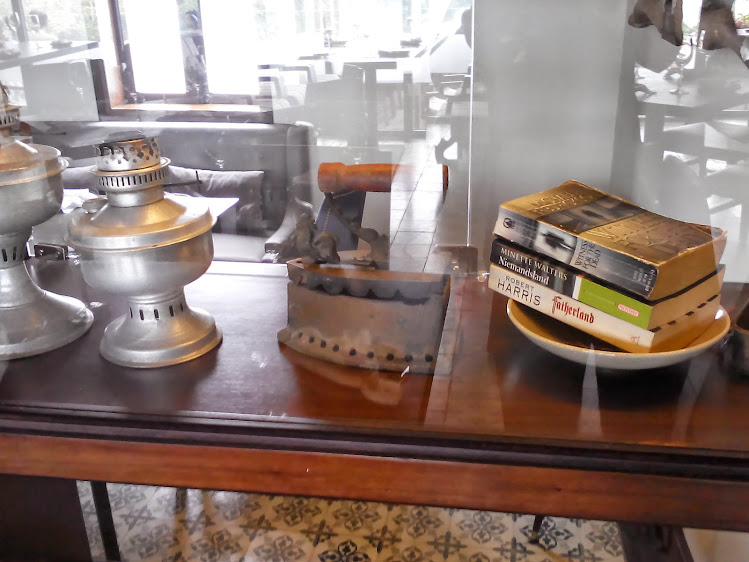
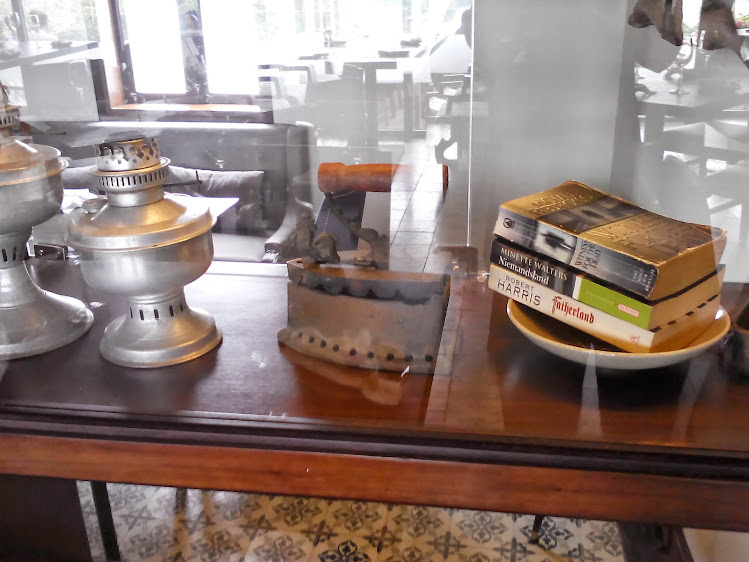
4. Coal iron 
During the period of governmental subsidy, there was an assumption that only rich people can own a coal iron. Such priceless utensil was utilized day and night; especially at the time Chinese New Year is closed by, it was shared among several families to help ironing the most beautiful clothes for Tet.

Only rich people can own a coal iron
5. Radio 
Before and up to the period of governmental subsidy, updating the news or listening to music through a radio is indispensable spiritual activity for so many people. To own a radio, one has to spend a few ounces of gold and so it usually appears only in wealthy families, the household business or government officials.


6. Butterfly Sewing Machine
Butterfly Sewing Machine originated from China. During the 70s of the 19th century, it appeared only in wealthy families and was the " dowry " dream of all girls who prepared to get marriage. At that time , only this machine had reverse gear. Therefore, it was famous for possessing superior technologies Vietnam than any other sewing machines ..

Butterfly Sewing Machine originated from China
7. Calor fan
Originated in France, the Calor fan was introduced to Vietnam under French occupation (the 30s of 19th century). Only the rich people and the one who is working for French Government can buy it. After the August Revolution, the Vietnamese people still kept them for utilizing.
Calor fan was introduced to Vietnam under French occupation

Sunday, April 27, 2014

The Heritage of Vietnamese - The museum at Cau Go (part 1)

The museum at Cau Go
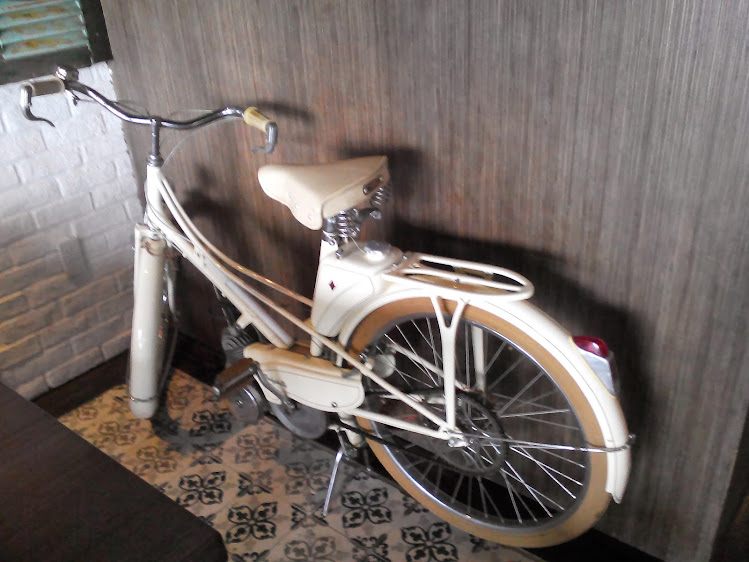
1. “Thống Nhất” bicycle (Unification bicycle)
1.1. This is a bicycle of famous Vietnamese brand “Thống Nhất” (in the 70s of 20th Century). During the period of governmental subsidy, such thing used to be a fortune for any Vietnamese family at that time (worth around 1.2 ounce of gold). As a result, the government had required each owner to register and update the situation/ location of their bicycle for regular supervision.
“Thống Nhất” bicycle (Unification bicycle) 
1.2. This bicycle used to belong to the defunct grand-father of the investor. It reminds him a lot of his childhood and his grandpa, who used to carry his grandson to school with his old bicycle. (1987) (It is a piece of precious memory about the respectable grandfather and the difficult childhood of the investor).
A piece of precious memory
2. Bát Tràng chinaware
The pottery village of Bat Trang was fist renowned in the 15th Century under King Tran’s reign with its own speciality “ivory-like enamel, crackleware”. In praise of the skills from Bát Tràng artisans, there was a pair of parallel sentences: From “Bạch Bát”, through the skills, mud turns into precious. Firing stove, through tempering, earth turns into gold.
“ivory-like enamel, crackleware”
3. Western oil lamp
Western oil lamp (or American oil lamp) was presented to Vietnam by the end of 19th Century – beginning of 20th Century – by the American oil company – Shell. These days, in the remote area where people haven’t been provided with electricity.
American oil lamp

Monday, March 24, 2014

The Heritage of Vietnamese - "Dó paper"

Menu on Dó paper at Cau Go Vietnamese Cuisine
Nowadays, thanks to high technology, paper is not a rare product like it was centuries ago. We have many paper choices of different thickness, brightness, color and even smell. However, some pieces of Do’ paper, a Vietnamese traditional one always make me delighted as they remind me about my childhood when my grandfather showed me his precious books and beautiful paintings on such kind of paper that until now I have still kept as a private treasure. I was told about the story of Do’ paper by our beloved grandpa long time ago and I always love to share it to my Vietnamese especially foreign friends when we talk about interesting Vietnamese heritage. And as usual, I’d love to share my story to you via this cozy blog.

Beautiful paintings on Dó paper
Dó paper is made from the bark of Dó trees traditionally produced in many villages in Northern Vietnam and mountainous areas. The paper material is soft but really durable. It is surprisingly estimated that the paper could maintain its quality upon 500 years old. Moreover, When drawing or writing on Dó paper, the drawing lines are not blurred, but contrarily quite sharp that’s why the paper was preferably used for paintings or royal documents in ancient time.

When drawing or writing on Dó paper, the drawing lines are not blurred
Dó paper is simply handmade and Dó papermaking is very sophisticated and time costing. It takes about 3 months for the bark soaked in limewater before it can be used for making paper fibers which adhere to the mold in a thin sheet that is then pressed, dried, rolled, and dried again until the final product – Dó paper- is soft, light, and durable enough according to strict standards. As such, Dó paper symbolizes for Vietnamese people’s hard working, patience and creativeness.

Dó paper symbolizes for Vietnamese people’s hard working, patience and creativeness
Today, the paper is widely used in painting, writing or valuable decorations.

Famous painting on Dó paper from a famous handcraft village of Dong Ho - Hanoi
The idea of showing our menu on Dó paper at Cau Go Vietnamese Cuisine Restaurant came into my mind long time ago since I dream about opening a special restaurant which not only offering exquisite cuisine with fabulous views but also present a sophisticated Vietnamese traditional décor reflecting in every details. I am very happy that Cau Go Restaurant is the first restaurant in Vietnam create a menu on Dó paper that becomes a delight to our prestigious patrons.

A sophisticated Vietnamese traditional décor reflecting in every details
Whenever Vietnam is in our heart, every small piece of it becomes special and valuable to us!

Friday, March 21, 2014

The Heritage of Vietnamese - Impression of French architecture

Wall decoration at Cau Go Restaurant reflects the influence of French achitecture on buildings of Indochine Colonies
Hanoi used to be the capital of French Indochine from 1887 to 1954. During that time, the French attempted to rebuild and transform it to an European style city which was supposed to reflect the power of France in the Far East . Hanoi was previously inundated with little lakes; many of these were drained to prevent malaria that is also a reason why the wooden bridge – the symbol of Cau Go street which connected Hang Dao Street to Hoan Kiem District disappeared.

Hanoi reflects the power of France in the Far East
Hanoi achitecture reflects the power of France in the Far East
60 years has passed, however, many of the French art and deco styles are still imprinted in the architecture of Hanoi. Although Vietnam did not lose its traditional color but it has absorbed inevitable perspectives from a modern France. It is not surprised that the tree lined boulevards, villas, churches, hotels, and grand government buildings under French architecture still dominate the city and contribute significantly in creating a unique, magnetic and charming Hanoi with its elegance and nobility.

many of the French art and deco styles are still imprinted in the architecture of Hanoi
Many of the French art and deco styles are still imprinted in the architecture of Hanoi
Since French architecture penetrated into Hanoi, a large number of buildings has been revised or built upon different styles such as Art Deco Style, which is designed with simple shapes, Neo-Gothic Style for churches and Rural style for villas with memory of French of their homeland. The combination of French format with other architectural culture of Vietnam and China was also a highlight.
he combination of French format with other architectural culture
The combination of French format with other architectural culture

A type of rectangular wooden window painted in green is typical for Art Deco Style that reflects in many governmental buildings and private houses in Hanoi in the 1900s. At Cau Go Restaurant, we put it on the wall inside together with precious pictures about the Old Hanoi in black and white as well as valuable ceramic plates which are over 100 years old.

A type of rectangular wooden window painted in green at Cau Go  Restaurant is typical for Art Deco Style
A type of rectangular wooden window painted in green at Cau Go  Restaurant is typical for Art Deco Style 
Come to Cau Go Restaurant to experience and learn about the charming Hanoi at its true identity !